I first read about Mousetrapped a while back and naturally, I put it on to my to-read list and I finally got round to it after reading a couple of heavier fiction books. Mousetrapped follows Catherine as a young, Irish twentysomething who is feeling a bit at a dead-end in her life and decides to chase one of her childhood dreams: to go and work at Walt Disney World. You can see why I was intrigued by this, right?
However, it is interesting to point out that Catherine isn't actually working for Disney, she's working for another company which operates the Swan and Dolphin (or the Duck and Tuna) hotels within the resort so I was weary about reading her experiences working in Disney.
Understandably, Catherine details her life a little bit pre-Florida and while she was out there. We learn her motivations and her pixie dusted dreams before she steps onto the flight to Orlando. While in Orlando, we follow her ups and downs while adjusting to her new life: awful apartments, loneliness, once in a life time experiences and more.
Catherine is actual quite a likeable writer and her enthusiasm is contagious. For example, although I have always wanted to go to the Kennedy Space Center, I'd never really felt bothered about seeing a Shuttle launch there and now, after reading her recount of one, I really want to see one! Even in her lowest points, she clings onto a tiny piece of Disney magic which helps get her through those more challenging times.
However, at times, I wanted to scream at her for being so naive when it came to her lack of planning and her reaction to certain things within the book. Oh, and also the fact she was happy to drive around illegally pretty much for the duration of her stay. Like I said, it was just naive.
I would have liked to read about the ins and outs of working in the Disney resorts and its perks; although, working for this hotel didn't even grant her free park access so I guess she only had a limited view of the parks and in some ways was a 'regular' tourist.
Overall, I did enjoy this book although it's definitely not a "warts and all" read about being a cast member. It's a pleasant retelling of Catherine's eighteen months in Florida, documents her highs and lows. I like reading about the inner and outer workings of places like hotels and theme parks, so perhaps I would have liked to read a little more about that, rather than just casual overviews of her time working there. All in all, it has got me even more excited and my year as a cast member!
Disnerds, have you ever heard of or read Mousetrapped?
Showing posts with label books. Show all posts
Wednesday, 6 May 2015
Sunday, 12 April 2015
Reading American Literature : The Sun Also Rises by Ernest Hemingway
I just finished my first Ernest Hemingway book, perhaps one of the most famous and influential twentieth century American writers. It was really interesting to read this book straight after House of Mirth as they are so different in style yet are both tragic and both novels feature some desperately unhappy characters.
Interestingly, The Sun Also Rises is on so many different "books to read before you're 30" lists so I'm glad I got there in the nick of time! With Hemingway, you're able to stumble through drunken youth and all of its highs and lows, in both Paris and Pamplona during the San Fermin festival. The Sun Also Rises centres around a group of friends from the "Lost Generation" in the 1920s and the repercussions of the First World War, the effect it has on people both physically and mentally. Jake, our protagonist, and his friends drink, gamble and generally debauch their way through life and yet, it doesn't make them happy. They believe that one more absinthe will take away their depression or unhappiness, yet it never does. The heavy weight of the effects of the War presses onto them and perhaps causes them to lead their pointless and to a certain degree, aimless life.
I'm not sure why but I didn't really warm to many of the characters; I found Jake quite endearing, he's hopelessly in love with Brett who refuses to be tied down to one man. Brett is an extraordinarily independent woman - something that struck me as very different to the females in House of Mirth - however, at times, Hemingway condemns Brett's behaviour, suggesting that her female presence is disruptive and poisonous amongst a group of male friends. As a woman, I'm not entirely sure how that makes me feel!
I really enjoyed Hemingway's style of writing. He uses prose sparingly and you don't have to contend with endless flowery description. It's very dialogue heavy and this can help envelope in the characters' world. However, I found it quite difficult to passively read this book: you need to be aware of what's not being said as well as the words written on the page.
I'll be honest and say that I only really realised the impact of this novel after I sat down and thought about it. While I was reading, I tended to take it on surface value (perhaps I wasn't in the mood to read such a book) but on reflection, it's clear the impact that Hemingway wanted to have. The ending, to me, is so desperately sad and poignant, without being explicitly so and it's Hemingway's ability to convey feeling and emotion without being obvious that means this novel is powerful.
Have you ever read any of Hemingway's works?
Sunday, 29 March 2015
Reading American Literature : The House of Mirth by Edith Wharton
I've read another book related to my exploration of American culture through literature and this time, the book was The House of Mirth by Edith Wharton. The House of Mirth covers another era of American history - between 1876 - 1905 - and deals with the elitist, upper crust sector of society in New York.
Our protagonist is Lily Bart, a beautiful, young, single twenty something who is on the hunt for a rich husband, so she can stay living amongst the high fliers of society. It sounds quite Gossip Girl-esque and at times, it does feel like that only with more serious undertones. Lily may be schmoozing with the people-to-know but she's more than aware that they will drop her at any given moment.
It's often hard to know whether to feel sorry for Lily or be angry at her; she desperately wants to stay a part of this society and we watch her struggles and demise, however, she is more than aware of how the cruel machine works.
Life among the wealthy is as opulent and luxurious as it is moral-less and unethical. People lie, cheat, gamble, gossip and backstab. Lily tries to navigate all of this to keep in with the rich and powerless and unfortunately crosses of one the main players which leads to her downfall. It's almost painful to watch her fall from wealth and decadent parties to her impoverished life as a failed hat maker.
The House of Mirth offers an interesting look into the American class system: it's purely dictated by wealth. If you have money, you have power. If you lose your money, or cannot marry into money (as Lily wishes), you have nothing. It contrasts so much to our own class system; money is a part of it but here, it's more to do with nobility and 'breeding'. It seem to be a common notion in this time that the rich get richer while the poor get poorer and once you've lost your footing in the wealthy world, you're out.
It also makes you think about the role of women within society. Lily is beautiful, intelligent and adept yet she is still judged on her lack of husband. She reasons that no one will take her seriously or that she will not have a fulfilling life if she doesn't marry a wealthy husband. She forgoes true love in search of a husband that can offer her more materialistically. Her reputation is ruined because of gossip yet the men in the novel can act how they please without repercussions. Is this something that still occurs today? I think, to a certain degree, it is.
I can imagine that Lily is one of those love-hate characters. I personally liked her a lot, she's bright, funny and interesting. She gets lost in a society that she cannot control or manage, and that in turn, destroys her. The House of Mirth is a tragic, period story that still resonates today.
Next up: Ernest Hemingway!
It's often hard to know whether to feel sorry for Lily or be angry at her; she desperately wants to stay a part of this society and we watch her struggles and demise, however, she is more than aware of how the cruel machine works.
Life among the wealthy is as opulent and luxurious as it is moral-less and unethical. People lie, cheat, gamble, gossip and backstab. Lily tries to navigate all of this to keep in with the rich and powerless and unfortunately crosses of one the main players which leads to her downfall. It's almost painful to watch her fall from wealth and decadent parties to her impoverished life as a failed hat maker.
The House of Mirth offers an interesting look into the American class system: it's purely dictated by wealth. If you have money, you have power. If you lose your money, or cannot marry into money (as Lily wishes), you have nothing. It contrasts so much to our own class system; money is a part of it but here, it's more to do with nobility and 'breeding'. It seem to be a common notion in this time that the rich get richer while the poor get poorer and once you've lost your footing in the wealthy world, you're out.
It also makes you think about the role of women within society. Lily is beautiful, intelligent and adept yet she is still judged on her lack of husband. She reasons that no one will take her seriously or that she will not have a fulfilling life if she doesn't marry a wealthy husband. She forgoes true love in search of a husband that can offer her more materialistically. Her reputation is ruined because of gossip yet the men in the novel can act how they please without repercussions. Is this something that still occurs today? I think, to a certain degree, it is.
I can imagine that Lily is one of those love-hate characters. I personally liked her a lot, she's bright, funny and interesting. She gets lost in a society that she cannot control or manage, and that in turn, destroys her. The House of Mirth is a tragic, period story that still resonates today.
Next up: Ernest Hemingway!
Sunday, 1 March 2015
Getting into poetry
What do you think of when you hear the word poetry? I know I used to see it as something way out of my intellectual league; some obscure, arty, and incomprehensible form of literature. I always enjoyed reading poetry at school, the way you can read between the lines and the skill and talent the author must have when they pick out one word to encompass a whole range of emotions and feelings. But after school, poetry dropped off my reading radar. Recently though, I've found myself gravitating towards reading poems. I think it started with seeing beautiful, poetic quotes from poets or writers I recognised on Pinterest and since then, I've even bought or been gifted a couple of poetry anthologies so I thought I'd share what I've been reading.
My first foray into the world of poetry anthologies was Penguin's Poems for Life. The book is divided up into sections, mapping our lives from the moment we are born to after we have died, poems of mourning or commemoration. It includes modern day poets like Carol Ann Duffy and Lemn Sissay and classic poets Chaucer and Shakespeare. In it, I found poems that I hadn't read for years and re-reading them was like a lightbulb switching on in my mind and taking me back to years ago! Poems that remind me of people or certain times in my life. What I love about this book, is that it's so accessible: you don't have to know much about poetry at all. Great for newbies like me!
Veinte Poemas de Amor y Una Canción Desperada is an anthology by Pablo Neruda. Although my copy is in Spanish, he writes some of the most beautiful poems I have ever read. I've heard that the English translations do not do the complexity of his language justice but I would definitely recommend looking him up His sonnets are also well-known and equally stunning.
The latest anthology I have bought is Poem for the Day One, which has a poem from every day of the year. I think that's a nice way to start introducing yourself into poetry as it can be so overwhelming to think where to begin! This anthology covers a wide range of poets, eras, and styles, similar to the Poem's for Life collection. When I first picked this book up, I just started looking up important dates to me and began from there. Again, it's a lovely way to introduce yourself to the world of poetry amd I have the following editions on my 'to-buy' list!
What I love most about these books is that you can pick them up, have a flick through for two, five, ten minutes, whatever time you have, and read. Sometimes I do think about them a little bit more or other times, I just let the words wash over me. You can gain so much from reading a poem and sometimes one or two lines just stick with you throughout the day.
Do you enjoy poetry?
Sunday, 15 February 2015
Exploring American culture through literature : East of Eden by John Steinbeck
I've just finished the third book on my list that deals with American culture, East of Eden by John Steinbeck; perhaps one of the most well-known American authors.
My initial reaction is that I enjoyed this book, I picked it up and put it down over the course of six days and I managed to get through it. I anticipated it taking me a lot longer to read since it's over 700 pages long so the fact I read it in less than a week speaks volumes to me.
Steinbeck considered this book to be his greatest work and it does have an air of grandiosity (although I understand why others may say it's pretension!).
The book meanders across a huge time span, from the American Civil War until the First World War. We follow the stories of two families throughout the course of a few generations, which means that you are quite invested in the characters' lives and their journeys. The only downside, for me, was that, a few of the characters weren't present throughout the whole story and they were monumental characters that had a huge impact on me and the book.
The book also alludes to a lot of biblical references; it's called East of Eden, characters have parallels to Adam and Eve and Cain and Abel. Even as someone who is not particularly well versed when it comes to the Bible, the themes running through the book were pretty clear. You also have the fact one of the main characters is called Adam and others Cal and Aron. It obviously gives the book a solid moral backbone.
The book explores the idea of identity as well and this gave me an insight into the melting pot of American culture. Lee, who is a Chinese immigrant in the States, stated that he got treated as a foreigner in the States and when he went back to China after growing up in the States, he was a foreigner there as well. It's a very interesting concept as I imagine it's something that a lot of people can relate to.
As I said, I enjoyed this book but the heavy religious symbolism and themes made it a little inaccessible for me. However, I can see why it is said to be one of the most revealing pieces of American literature. It reveals the progress of American culture from the Civil War to the First World War, both on an industrial/technological and a family level.
Have you ever read any of Steinbeck's novels?
The book also alludes to a lot of biblical references; it's called East of Eden, characters have parallels to Adam and Eve and Cain and Abel. Even as someone who is not particularly well versed when it comes to the Bible, the themes running through the book were pretty clear. You also have the fact one of the main characters is called Adam and others Cal and Aron. It obviously gives the book a solid moral backbone.
The book explores the idea of identity as well and this gave me an insight into the melting pot of American culture. Lee, who is a Chinese immigrant in the States, stated that he got treated as a foreigner in the States and when he went back to China after growing up in the States, he was a foreigner there as well. It's a very interesting concept as I imagine it's something that a lot of people can relate to.
As I said, I enjoyed this book but the heavy religious symbolism and themes made it a little inaccessible for me. However, I can see why it is said to be one of the most revealing pieces of American literature. It reveals the progress of American culture from the Civil War to the First World War, both on an industrial/technological and a family level.
Have you ever read any of Steinbeck's novels?
Sunday, 1 February 2015
Exploring American culture through literature : Let The Great World Spin by Colum McCann
The first thing that really struck me about this book is it's portrayal of New York being a living, breathing entity. The city is described with such precision and life, it really reminded me of A New York Winter's Tale. New York, it seems, can either be a beautiful creature, presenting its inhabitant's with countless opportunities and pleasures, or a beast that can eat you up, suck out your soul and then spit you back out, and even though it treats you like this, you still belong to the city and the city belongs to you.
The novel is set in post-Vietnam, mid 1970s, just after the construction of the Twin Towers. The World Trade Center acts as a kind of focal point which joins together all the stories and lives of the characters. The Twin Towers unite people from all creeds, colours and backgrounds, and it seems extra poignant to me that we found ourselves in similar situation only forty years later.
Let The Great World spin is a multi-layered portrait of life in this area and as I said, overlays and weaves together the lives of very different people, from the a judge and his wife living in the Upper East Side, to prostitutes in the Bronx, ex-pats and more. It really drives home the message that although these people are incredibly different, they all live through the same fundamentals in life: they love, they grieve, they make bad decisions.
I really enjoyed this book: it was challenging without being hardwork; it was beautiful, yet gritty and real; it gave a honest insight into a city that struggles to be contained onto pages. The protagonists came to life in their own chapters, some more likable than others, but all genuine and believable. There are no less than eleven main characters in this story and it seems like a feat to drive the story forward when you are creating so many in-depth and three dimensional characters. This book has made quite an impression on me and I'm sure that if I ever get the opportunity to visit New York, I will think more about its complexity and facets as it continues to grow and evolve.
Next on my list is John Steinbeck's East of Eden.
Tuesday, 13 January 2015
Exploring American Culture Through Literature : Beloved by Toni Morrison
I thought I'd take a deeper look into the culture of the country I'll be living in for a year and what better way to do that than reading? American literature is such a vast and complex branch of literature but luckily for me, help was at hand in the shape of Dena, my resident American studies graduate!
I've got a list of books that I'm going to hopefully work my way through before Florida. I've read a couple of the 'must-read' books about American culture like The Great Gatsby and On The Road (even though I didn't particularly enjoy either of those books!), I'm hoping I'll find some books that I love!
The first book I have read is Beloved by Toni Morrison, a Pulitzer Prize winning novel, so naturally, I had high hopes. I really enjoyed this book, it wasn't a horrifically taxing read but you still feel that you can get your teeth into the dark and horrifying subject matter.
Firstly, the story revolves around an escaped slave Sethe in Ohio, and although she has managed to escape the shackles of being a physical slave, there is something a lot darker holding her captive. Morrison creates an incredibly complex and vivid character, who unfolds as you get further into the book. Sethe is central to the story and the role of her family is to weave and interlink throughout society and indeed, the black community feel that was evident and important at that time.
This book made me contemplate atrocities that I cannot begin to comprehend. It was written so plainly and openly on the page that you cannot shy away from the words, you have to read, live and deal with them in the same way that our protagonists did. The slaves were freed by the law, legal citizens, but they still dealt with the same prejudices, racism and treated as second class citizens. One particular reference that shocked and stood out for me was where Sethe realises that white pupils were being asked to write down what animal characteristics black people had. To think that real people lived through this kind of treatment, well, honestly, it makes the bile rise in the back of my throat.
However, it wasn't all negative in this book. Toni Morrison makes every word count; there are beautiful descriptions and imagery that jumps off the page into your mind, combining the supernatural and the physical world seamlessly. I was whisked between scorching hot days in the Mid-West through to ice-skating on frozen lakes in the icy winter. For me, the beauty of the language acted as a harsh contrast to the realities of slavery and the abuse and torture that black people went through at that time.
I'd go so far as to say that this book could sit in the horror genre. It is truly haunting, in both content and language. It's spine-tingling and raised similar questions in my mind as The Turn of the Screw, you're almost left asking what's real and what's not.
A quiet, understated novel that will make you question on pretty much every page.
Sunday, 26 October 2014
Reaching my Goodreads target
In June (ages ago, I know!), I reached my very modest Goodreads target of twenty five books. It's a very small target to a lot of readers and to a certain extent, for me, but working in Mexico left me with a lot less free, reading time. Needless to say, I was very pleased when I hit my target half way through the year and have managed to get through a few more books since then. I thought I would share which books I have read so far, and highlight my favourites!
1. Eleanor & Park by Rainbow Rowell
I loved this book, I wish I had written a review on it. A beautiful, lovely story about an unlikely couple of teenagers in love. It was funny, sad, smart, observant, and I couldn't put it down!
2. Forgive me, Leonard Peacock by Matthew Quick
Reminded me a lot of The Catcher In The Rye - check out my review.
3. The Cuckoo's Calling by Robert Galbreith
A fine detective novel under JK Rowling's pseudonym. Despite a lot of disappointing reviews, I really enjoyed this novel. I love the detectives a la Harry Hole and Cormoran Strike was a fulfilling British equivalent. The Silkworm was an enjoyable read too and I hope the series continues.
4. The Color Purple by Alice Walker
I don't know why I hadn't read this book before. A moving novel set in rural Georgia that deals with racism, sexism and traditional gender roles. I love a book that makes you think and this book certain does that.
5. The Spectacular Now by Tim Tharp
Another great coming of age novel; the movie is pretty good too!
6. The Book Thief by Markus Zusak
I adored this book, I think it is one of my favourites. It's beautifully written and almost unique in it's narration. The second book to ever have made me cry! I can't recommend it highly enough.
7. Horns by Joe Hill
I read this book because it was on a book to movie adaptation list and I was very pleasantly surprised. It was witty and made so many spot on remarks about life and religion. It had me laughing out loud on several occasions.
8. To Kill A Mockingbird by Harper Lee
Like The Color Purple, this book is on many English Literature syllabuses and I can't believe I hadn't read it before. I loved this book; it addresses so many issues and themes that fascinate and sadden me. Atticus Finch is literary hero and I can understand why.
Have you read any stand out books this year?
Twitter | Bloglovin | Instagram | Goodreads
Sunday, 3 August 2014
A review : Prime Deception by Carys Jones
I received a free copy of this book, in exchange for an honest review.
I'm a big fan of crime thrillers, especially those with strong story lines and twists and turns that keep me guessing every step of the way. I would never have thought that crime thriller would blend very well with a romantic story line, but Prime Deception manages to mix the two quite nicely.
We learn that the Deputy Prime Ministers' lover has supposedly committed suicide, but her twin sister and the Minister himself find that difficult to swallow. We follow the characters trying to unravel the truth, which in turn, slowly reveals each characters intimate thoughts as well as their flaws and shortcomings.
Jones' writing drives the story along and takes us from one situation to another fluidly and with great ease. I love the way Jones' moves smoothly from one character to another, linked by a thought or an idea. To me, it's almost like a stream of thought on the page; the move from one character or setting flows seamlessly, it doesn't feel forced and still allows the reader an omniscient-like view of the situation.
The characters were pretty well developed: I felt the main characters were multi-faceted and there seemed to be a sinister side to Charles, the Deputy Prime Minister, which was hinted at but not really developed, and I think it could have been unearthed or maybe built upon a little more. I also had a few issues with some of the minor characters: there seemed to be lots of little characters introduced who then just disappeared. A journalist, for example, who seemed poised to be a major and influential character, but who just turned into a dead end.
The suspense didn't really build until the very end of the book, but honestly I was okay with that. I'm happy to guess the culprit without big flashing, neon signs pointing to the clues. It isn't a traditional thriller book, but an almost 'softer' thriller; there is more development in the characters feelings and emotions, as opposed to unravelling the mystery bit by bit.
My major gripe with this book is that my copy was very, very poorly edited. I can forgive one or two mistakes, but the book seemed to be littered with typos. I find books with that many mistakes difficult to read as I become fixated on the errors instead and struggle to see past them.
Overall, it is a fairly solid book. Jones' writing style is interesting, likeable, and for me, the asset to the novel. The story line is good, not as many twists and turns as my favourite crime books and I did predict the killer, but a fine book to dip in and out of when you fancy an easy read.
You can buy Carys Jones' Prime Deception from Amazon.
Twitter | Bloglovin | Instagram | Goodreads
Sunday, 13 July 2014
Never Fall Down by Patricia McCormick : a mini review
That's definitely not to say that this book wouldn't have hit home, it's a truly harrowing, real life story of how a young Cambodian survives the tortuous regime of the Khemer Rouge in the 1970s for four years. The story is narrated by Arn, who is eleven years old when his whole world is turned upside down when the Khemer Rouge (the communist movement, led by Pol Pot) comes into his town and marches everyone into the rice field to work as slaves and provide for the Angka. Men, women, and children are all murdered during this regime, either in cold blood or they waste away and die of starvation or illness. The fact we see the se horrors unfolding through Arn's initial child eyes, for me, makes it extra disturbing. Arn quickly has to grow up in the most awful of ways, he encounters horrors on a day to day basis that most of us cannot, and will never be able to, understand. His innocence and youth are ripped away from him; his story had a profound effect on me.
The book is written in patois but it is not difficult to understand, you quickly get used to Arn's Cambodian English. This dialect allows you to be transported into Arn's shoes and really captures his voice and the setting. McCormick states in her authors notes that she tried to impose grammatical rules and structure onto Arn's story but it lost a lot of his personality, and retaining the patois makes the book even richer and the story even more realistic, drawing you in.
The book, understandably, contains a lot of violent imagery. At times, it's not easy to read and the violence and death of the times is portrayed crystal clear through the pages. Again, though it may make for uncomfortable reading, it's important that these facts and ordeals are preserved in plain, violence language in the same way they were committed, for both the story and humanity. Arn found himself in situations that fortunately, the majority of us will never have to deal with, and McCormick does great justice to his story with her telling. She is able to artfully and respectfully pad out Arn's story where his memory is vague and the story flows, heartbreakingly along.
There has been a lot of discussion whether this book is indeed situable for the young adult audience to which it is aimed. I think it could potentially be a difficult read for an early teen, not so much becaus of the language, but because of the content. However, I would encourage any young adult to give it a try, after all, the Khemer Rouge regime was real, thousands of people, children included, lost their lives during the genocide and it would be disrespectful to downplay their story and lives. This subject matter should be difficult to read, thought provoking and challenging.
Overall, I couldn't put this book down and I read it in two short sittings. Once again, I did find it incredibly difficult to digest at times and heartbreakingly sad, but with glimmers of hope through various 'characters' in the book. Arn is truly a testament to the strength of human spirit. An incredible, reflective journey through an harrowing era of our World's history.
Sunday, 6 July 2014
The Age of Miracles by Karen Thompson Walker : a mini-review
However promising this book seemed, it disappointed me overall. It could have been so much more, Thompson Walker raised some interesting points about how society would react under these circumstances but then quickly brushed over them and we, the reader, just have to learn to accept them. It would have been so interesting to go into further detail about how the human race copes with an uncontrollable change. Unlike dystopian novels that are set in the future, this novel had the opportunity to dissect what happened during that change, and in The Age of Miracles, it just wasn't made the most of and felt like a lot of missed opportunities.
Another issue that I have with this book is the voice of Julia. At times, there are wonderfully descriptive and well written prose that capture the mood and thoughts of our protagonist. However, at other points, I felt like Julia's voice was too young for the readers. Things were simplified and condescended the reader. This is a young adult book and I'm pretty sure I don't qualify as a 'young' adult anymore but readers do not need to be treated like small children. Maybe Thompson Walker wanted her protagonists voice to feel like the 11 year old's she was describing, but for me, language from the young adult genre do not have to be overtly simple.
Finally, the science. This novel is, of course, fiction and I am not a scientist nor do I particularly understand physics but there seemed to be gaping holes in the physics of the story. Please, feel free to correct me if I am wrong, but it doesn't seem logical that the slowly of the Earth's rotation would affect gravity. At the end of the book, there is a throwaway comment about centrifugal force which makes a little more sense (to me) but there seems to have been no research about the science. It's not a sci fi story, it's a coming of age tale, but it needs to be logical. The readers are not stupid. So many times I found myself wanting to google the different sciency aspects because it made so little sense to me.
Overall, I was disappointed by this book. It felt anti climatic and at times, the story dragged along with flimsy, whimsical subplots. It's a shame because it could have been so good, the idea of the Earth slowing and the effect that could have leaves you with so many what ifs and pondering thoughts that could have been addressed. It's a catastrophe that would affect everyone, and Thompson Walker missed out on a great opportunity and a fascinating idea.
Sunday, 29 June 2014
Forgive me, Leonard Peacock by Matthew Quick : a mini-review
On reading the description of this book, I wondered how Quick was going to handle the topic: a teenage boy plans to kill one of his classmates and then kill himself. Pretty depressing and hard to relate to stuff. But I had faith in Quick; he deals with tough topics and creates likeable characters with different problems and I loved The Silver Linings Playbook and to be honest, he doesn't disappoint with Forgive me, Leonard Peacock.
From the outset, we are aware of the protagonist's plan to carry out murder-suicide: he is honest, clearly depressed and hurt by the world. However, I felt drawn to Leonard. Of course, there is no justifying his intended actions but his disdain and disappointment by the world resonate true. To be honest, a lot depends on whether you can relate to Leonard, I think this book would have been harder to get into if I thought he was an unrelatable character. But I liked him. I liked that he felt he could trust his history teacher and was drawn to one positive person in his otherwise bleak world. Leonard reminded me a lot of Holden in The Catcher In The Rye; they both struggle with the "fakeness" of the real/adult world. Leonard is perplexed that people go to jobs they hate, every day of their lives when it makes them so unhappy and then to essentially lie about it. Quick captures this disillusioned teenage voice well and places you in his shoes; slowly revealing his story and justifications for his actions. Leonard is clearly a very intelligent individual (as shown through his perspectives in his favourite Holocaust classes) and chooses to challenge adult life, but unfortunately twisting it a little, in the same way Holden does in TCITR.
One aspect I loved about this book was how Quick uses and changes the language throughout the book. Most of the story is told from the first person perspective but on a number of occasions, he switches to stanzas instead of prose and this had a beautiful, poetic effect. One chapter is extremely powerful: he uses one word per page and although it may sound a bit arty and over the top, it was a perfect use of the layout at a crucial moment in the book - I held my breathe turning each page.
I read this book on my Kindle and this provided me with my only grumble about the book. There is extensive use of footnotes and often the footnote is quite detailed and long, often offering further explanation from Leonard, like his Wikipedia searches or a backstory. I liked this extra detail but on the Kindle, I had to keep clicking to follow the link and going backwards and forwards, sometimes losing my page. It's not an actual complaint about the story and maybe it's different in a paper copy but I felt going through all the rigmarole on the Kindle really disrupted my reading and the flow of the story.
Overall, I really liked this book. It deals with a difficult but all too real subject in the same thread as We Need To Talk About Kevin. For me, these events are all too frequent today and need to be dealt with and not shied away from. Quick does the subject justice, delving into a teenagers mind and trying to decipher the million feelings of loneliness, isolation and the layers that each indivual has; the human and monster in all of us. A thought provoking book that encourages us to keep fighting, against each adversity we face, and learning to live with the consequences of each event we have overcome.
Sunday, 22 June 2014
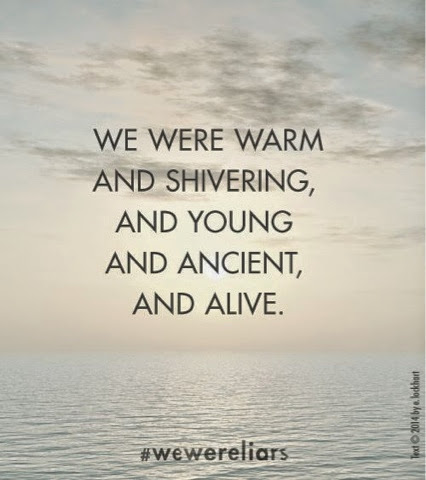
We Were Liars by E. Lockhart : a mini-review
It is written from our protagonist, Cadence Sinclair Eastman's point of view, detailing her family's lives and also their politics, over a series of summers spent on the outwardly perfect Sinclair family's holiday island. I don't want to give too much away - part of the magnificence of Lockhart's novel is the unravelling and up layering of the story. As far as I'm concerned, the less you know the better. Of course, all is revealed in due course, and although some may not be shocked or surprised, I think it's so perfectly executed that you will want to carry on turning each page until you discover the whole truth.
One thing that struck me the most about this book was the dark and poetic language. Often, the prose switches to stanzas, and for me, this is very powerful; it causes you to take note of the words and absorb and appreciate the gravity of every single one of them. If I'm truly involved in a book, I devour every sentence quickly; sometimes not noticing small details or deliberate choice of words because I just want to know what happens. In We Were Liars, the change punctuates the story and causes you to linger upon each short line, having a very powerful effect. The language itself is also dark, filled with angst and hurt. You can feel Cady's pain seep out of her and onto the page in vivid imagery, without the language being overly flowery or dramatic.
The story and characters parallel a dark fairy tale; Cady rewrites fairy tales to reflect her life and her feelings towards her family. These fairy tales offer a kind of stream of consciousness and reveal to us her feelings towards her perfect family and also the pressure she feels with being the eldest daughter. Throughout the story, Cady is filled with anger and disdain for her family and their pretence of perfection. We are able to relate to her and her cousins and friend, as they seem like typical teenagers growing up and starting to challenge the expectations of their parents and indeed, society.
As I said, I don't want to spoil the book but Lockhart leaves little breadcrumbs along the way to help you guess and unravel the plot. Some of the clues are very subtle and I enjoyed looking for them, but this is a complex and detailed story; some readers will prefer just to go along with it all instead of trying to figure it all out.
Other reviewers have said that this book is the perfect example of why adults enjoy reading young adult fiction, and I have to agree. It is not your usual, teenage angsty love story. It is an intelligent read, both in story and style of writing. You can feel the characters' emotions through the expressive language and written sentences; Lockhart doesn't spell everything out to you, she trusts her readers to be clever enough to understand the characters and their motives. We Were Liars is an impressive read and one that I would happily re-read and recommend to others.
Sunday, 8 June 2014
Paper Towns by John Green : a mini-review.
Paper Towns is the third of John Green's books that I have read. I started with the now hugely popular and well-known, The Fault In Our Stars, and then Looking For Alaska. Green seems to have found his niche in young adult fiction; fiction that pulls on your heart strings and allows you to reflect on everything that is good, bad, easy and difficult about life. I like this: Green doesn't talk down to his readers, he takes you on a sometimes painful or sad story, but you have time to figure the complex messages out for yourself instead of having it handed to you on a plate.
Paper Towns is no different: the main protagonist Q goes on a literal and metaphorical journey as he is trying to figure out Margo. Q is forced to recognise his own flaws after he has called out other peoples', something that we are all guilty of at times, thinking our own beliefs are right and dismissing anyone who disagrees, or is careless or disrespectful of our opinion. A highlight of Paper Towns is the diversity of the characters; we are introduced to a small group of friends in an American high school and Green portrays the complexity of each individual character, contrasting them, showing off their strengths and their weaknesses. Green has no time for two dimensional cardboard characters, he also doesn't care if a character is particularly likable or not, and for me, he deserves great commendation for this.
The main themes are, at times, quite brooding and sullen (suicide, disappearances) but don't let that put you off. The text is witty, well-written and smart with some hilariously inappropriate moments and jokes (a group of teenage boys graduating from high school - what do you expect?) which perfectly balance out the sombre moments or ideas. The novel is also a coming-of-age story, the characters finish high school, are going to college and Q sums up the feelings of 'doing something for the last time' perfectly; how hard it can be to end a certain chapter of your life. The road trip the characters take is also a kind of rite of passage: they all have their own role on the trip and they are searching for something, hoping it will change, but of course, it's not always that easy.
One particular theme that I liked a lot in Paper Towns was the idea that we create an idea of who people are. Green argues that we tend to create this perfect idea of those we admire, look up to,or love. We think they do not go through the same pain and suffering that we do or we romanticise them. Margo states that people love the idea of the 'paper girl', someone who is malleable, fold-able or unreal, yet these paper people can be broken and feel lost too, and sometimes the real them can get lost among what other people think they are. In a world of idolising celebrities, this concept is really interesting.
Green's talent for producing real, thought provoking stories for young adult (and older!) readers is a million miles away from the frothy romance of Twilight-esque books (nothing wrong if you like them, I have read and enjoyed them...). We encounter real life problems and situations that hurt us but restore our faith in humanity at the same time. Paper Towns is a wonderfully enjoyable book that charters the sometimes troubling waters of young love and growing up, with complex characters and the overriding message of how people are not always who we think they are.
Twitter | Bloglovin | Instagram | Goodreads
Sunday, 1 June 2014
All The Pretty Horses - Cormac McCarthy - a mini-review
Although I had heard a lot about Cormac McCarthy's work before, I had never given any of his books a try; I thought they would be too dark and full of desperation for me, even though I do like a challenging, thought-provoking book to get my teeth into. I first came across All The Pretty Horses in one of Waterstones' recommendations, it was a book they suggested you read if you love Mexico and after three years of the book title floating around in my head, I decided to give it a go.
Firstly, I thoroughly enjoyed this book, a lot more than I thought I would. It tells the story of a 16 year old bilingual Texan who wants to work on ranches, but unfortunately for him, this trade is quickly dying in the United States in favour of a more lucritive business: oiling. Our protagonist, John Grady Cole decides to cross south of the border into Mexico in pursuit of his ideal life, and we see that it's not always that easy.
Secondly, it seems that All The Pretty Horses isn't quite as dark as McCarthy's other pieces of work, but that's not to say that it's all roses. There are passages and ideas that are, frankly, quite depressing. But not depressing for the sake of making us, people, mankind, feel bad; they are honest commentaries on life and society, and one teenager's romanticised, idealised view of the cowboys' code of honour. It's also a very interesting restructuring of the "American dream": we are used to seeing people in search of the better life in the United States, but All The Pretty Horses presents Mexico as the country to fulfill this dream.
Another interesting and challenging aspect of this book is McCarthy's writing style. McCarthy doesn't follow standard Westernised punctuation; there are long, flowing descriptions of the countryside that often require a reread. On numerous occasions, one sentence can be as long as a paragraph. However, it's worth taking the time to absorb these incredibly detailed and beautified descriptions of the Northern Mexican States, the desert, and the sierras. One chapter that was particularly special to me was when John Grady visited the city of Zacatecas, a city that I have visited, and the character stayed in the same hotel I stayed in. Reading the description of the colonial city, the winding roads and open plazas made me feel like I was there again, every detail was covered.
There is also extensive use of Spanish in the book; of course, it's largely set in Mexico. For me, I adored this, obviously speaking Spanish made it a lot easier to understand, but I would guess even if you had no knowledge of the language you would be able to understand either from the context or a later description. I loved this detail of the book, I have never read anything like it. Again, the story deals with cattling and the cowboy lifestyle so there are a lot of horse and cowboy related vocabulary but I wouldn't let this put you off, you quickly become savvy with the lingo -both in English and Spanish!
Finally, I was really surprised how much I enjoyed this book. I would never normally pick up a book from the Western genre but it's so well written and distinctive from anything I have read recently. The story displays the strength of human spirit, in spite of belief breaking adversity and how we can hold on to whatever we desire, if we want it hard enough. All The Pretty Horses is part of a trilogy, but I believe the following books are not sequels as much as stories to run alongside this book. All in all, Waterstones was right: if you love or are interested in Mexico, it's definitely worth the read. I should have read it earlier. It's also worth a read if you like a book that challenges you linguistically and questions your ideas.
Twitter | Bloglovin | Instagram | Goodreads
Friday, 30 May 2014
Reading moves you.
I have been thinking about how much I love reading recently and what impact it has on me. I'm not sure how, or why, my love of reading has stuck with me throughout my life; my family are not readers, my parents are busy and prefer to read a newspaper instead of a novel and my brother would rather be dissecting a car (or whatever he does, I don't know) than pick up a book. Once we began learning to read in primary school with the Roger Redhat books (anyone else remember those?), I remember my nanna spending a lot of time with me, listening and helping me to read. I think that is probably when I started to enjoy it, and although I was still learning, it took me away to another place.
I think in the UK we are lucky to have a reading culture and for me, it's a shame that a lot of people no longer take advantage of that. We are encouraged to read at school and a lot of importance is placed upon the English literature curriculum. We were talking with a couple of Mexicans the other night and a friend asked me how many books I had read this year. I answered, worried I was putting in a poor show, but the other Mexican hadn't read any; not a single book. I have also been speaking to the teachers at my school, and they have commented on the lack of focus literature in the high school curriculum: not a single poem, play or novel. I was shocked and to be frank, saddened.
So why I do think reading is so important? It can be really hard sometimes. Now, I appreciate the works of Shakespeare and Dickens, but that doesn't mean I would read it for fun. I remember slogging my way through the play, An Inspector Calls, looking for all the symbolism and themes and not particularly enjoying it that much at the time either. But now, looking back, I realise that these challenging reads have helped me form a greater understanding of the world; of history, of culture, of people.
You can delve into the mindset of a specific time in history, you can find the supporters and critics of a way of life. The Great Gatsby, for example, is a criticism of the extravagant, decadent party lifestyles of 1920s America. It's so easy just to take things on first appearance without reflecting or challenging that point of view. A book can throw everything you thought you knew into disarray, making you a more well rounded, perceptive and pensive thinker.
A good book stays with you throughout your life and although it's messages may no longer be relevant, they take you back to the moment when they were, in the same way that a song or smell transports you back in time. I can recall what point of my life I was at when I remember reading my favourite books for the first time, and also what I was inspired to read afterwards. I can remember passages of books that also made an impression on me in the same way that I remember my favourite scenes from films. A novel can be appreciated in a million different ways by different people. It's adaptable and personal, an escape or a reality check.
When people ask me what I like to do in my spare time and I say read, I still get some really weird looks, like it's the strangest thing I could possibly do in my spare time. But I'm glad I devote my free time and effort to this hobby. I have learnt and continue to learn so much from reading; learning and speaking another language is greatly helped by having a firmer grasp on your native tongue. How can you expect to master another language when you haven't mastered your own? Reading feeds into every part of my life: my vocabulary, my other hobbies, relaxation, blog writing, to name but a few. What's more, I'm sure that I will continue to unwind and de-stress through picking up a book and I will also continue to share my love for reading.
I think these quotes are much more concise in saying what I am trying to say!
“It is what you read when you don't have to that determines what you will be when you can't help it." - Oscar Wilde
"Books are the quietest and most constant of friends; they are the most accessible and wisest of counselors, and the most patient of teachers." - Charles William Eliot
"You don't have to burn books to destroy a culture. Just get people to stop reading" - Ray Bradbury
Do you enjoy reading?
Thursday, 1 May 2014
Allegiant - a mini review.
With Divergent hitting the cinemas this month, the books on which the movie was based have been getting equal publicity. Allegiant is the final book of Veronica Roth's young adult trilogy and completes Tris and friends' fight against evil, scheming dictators.
I read Divergent and Insurgent last year and although Allegiant was released in November 2013, I only just got around to reading it. I really enjoy young adult series, I find them entertaining, easy reads, and often thought provoking. Dystopian futures have become flavour of the month amongst young adult literature and the Divergent series follows in the same thread.
I'm assuming that you will only read Allegiant if you have read the other books in the series, because I don't feel that the book is strong enough to be a stand alone story. I read the other books under a year ago and I struggled to remember who characters were. Although I understand that series are meant to be familiar with the overall story, I like books that can be enjoyed alone even if you haven't read the entire series.
Allegiant is also the only book in the trilogy to be narrated from Four/Tobias' and Tris' point of view, giving us two perspectives of the unfolding events. For me, the only problem was that Roth's voice for these two characters sounded so similar that at times, I forgot whose chapter I was meant to be reading. Four and Tris are extremely different characters, I shouldn't have had to question whose mind I was in.
Another gripe I have with this book is the constant angst! I realise that life is pretty crappy for all the characters in the Divergent series but it felt like I was reading constant whinging. Tris would complain about Four's behaviour and vice versa. At times, it felt like Tris was just trying to be a martyr about everything and not trying to understand other characters point of view. I never got that impression of her before: I liked her character, but now, not so much.
I wasn't overly fond of the plot either; I think Roth was aiming for twists and turns, keeping the reader guessing who the baddie is but I just felt like we were on a wild goose chase; this person/entity is the baddie, oh wait no... This person is worse... Hold on, no! THIS person is also pretty nasty! Trust no one but Tris, she always knows what's best! I want more substance than that. The plot also gets lost in the science/genetics issues: worries that are valid in our ever advancing technological world, but for me, it just undermines everything else about the story: the factions, Choosing day, people's roles in the dystopian Chicagan society.
The ending - the massive ending, which I will not discuss much to prevent spoilers - I wasn't a fan. I didn't feel satisfied. I guess Roth was trying to highlight that we don't live in a perfect world, sacrifice, love, life, family but it doesn't sit with me.
I really, really wanted to like this book. I wanted Divergent to be a series that I could return to time and time again, but Allegiant has let it down. It wasn't a satisfying conclusion to a series that you could really root for, a world that you could get lost in, with some really likeable characters. To me, at times it felt rushed, and when I see that there are other mini stories written from this series (purely to make money, I would assume), it leaves a bitter taste in my mouth.
Saturday, 29 March 2014
A New York Winter's Tale - a mini-review
I never usually write book reviews, I leave that to the other excellent reviewers on Goodreads. However, every now and again a book comes along that I seem to have a difficult relationship with, and Mark Helprin's A New York Winter's Tale is one of those books.
I first came across the book on a "what to read before the adaptation hits the cinema" list, and to be honest, I love to read book-film adaptations. After seeing the film, I made sure that Helprin's book was my next read. Firstly, the book is really nothing like the film, they only share themes and a loose story line connection so if you adored the film and wanted to see how it read on the page, maybe you will be disappointed. The second thing I couldn't help but notice is that the book is really quite long, so if you are looking for an easy, quick read, again, it might not be for you.
A New York Winter's Tale is a book that needs time to be dedicated to it and is for those who are willing to give a book time to unfold a complicated and intricate storyline, that jumps to different periods of time where the character's lives criss cross and intertwine. It's a book for readers that truly love to read, those who want a book to challenge them and provide more than just escapism in it's purest form. Of course, there is nothing wrong with books that you can fly through and lose yourself turning each page as you easily absorb each word without consciously realising, I love those books too!
One of the most memorable things about this book is that it is truly beautifully written, as I said, it challenged me, I found myself looking up words (miasma!) and getting lost in the descriptive passages of the city and the landscape: I felt that New York City was alive, a creature growing, evolving, and hiding many secrets in its complex and diverse streets. It was a treat to read passages so lush and creative in their language. As beautiful as it was, it sometimes served as detrimental to the storyline itself, I got so lost in the descriptions that I forgot how it drove the story or for what purpose.
The writing works well alongside the book's genre of magical realism. I understand that this genre is either love or hate for a lot of readers, and for me personally, I quite enjoy it but you have to suspend your disbelief. A story about the stars, people who live for hundreds of years, a mythical horse and lake people that blends with the hustle bustle of mythic New York City during the industrial era as well as a modern day version, though distinctly different from our own.
It's difficult to sum up this book in a quasi review and my main problem is that I didn't feel satisfied at the end of the 700-odd page book. I had been through a journey with these characters but I didn't feel complete at the end. Maybe this book deserves and needs a second read in order to unravel the detailed commentaries on life, love, and morals. All and all, a remarkably written piece of magical realism, but one that requires a lot of time to truly immerse yourself in the story.
Friday, 21 March 2014
"There is no friend as loyal as a book"
Reading has been a massive part of my life for as long as I can remember. Some of my most vivid childhood memories are of my Nanna helping me read and throughout my life I can pin point certain moments because of what book I was reading. Books can offer us guidance or answers when we are feeling lost or broken, they comfort us, they pass the hours in a more engaging manner than just passively watching the television (although I do enjoy this too...) and what better feeling is there than seeing that it's 1.30 or 2am but you are so engrossed in a book that you don't want to put it down or go to sleep. Just one more chapter...!
In this blog, I'm going to talk a little bit about 5 books that have made an impact on me or have further flamed my love for reading.
1. The Catcher in the Rye - J.D. Salinger
This book heavily influenced another one of my favourite reads and coming-of-age novels, The Perks of Being a Wallflower by Stephen Chbosky.
2. The Bell Jar - Sylvia Plath
3. The Book Thief - Markus Zusak
The Book Thief is one that I read recently and I have never been through such a rollercoaster of emotions with one book. Set in Nazi Germany and narrated by Death, it is not a read that you get through in an evening. It's not necessarily happy. It broke my heart, the first book to make me cry since Marley & Me. Books written about the First or the Second World War always drive a knife into my heart, I, like so many people, find them so harrowing. I was really drawn to the character or narrator of Death, he struggles to understand humans, how they can be so kind and so evil at the same time. I ask myself if we don't all struggle to understand that aspect of being a human being at some point in our lives. The Book Thief made me laugh, cry, disgust at the actions of some humans at all the same time. It was one of those books that I could not put down and would stay up late at night, devouring all the words in the same way the Liesel learns to read. A sparkling story, written with so much human emotion, and one that challenges you and also for me, the way I act and how I treat people.
4. Stardust - Neil Gaimen
5. The Silver Linings Playbook - Matthew Quick
Also, massive kudos to Matthew Quick, I tweeted to say how much I enjoyed the book and he replied, showing his thanks. Kindness makes everyone smile :-)
In this blog, I'm going to talk a little bit about 5 books that have made an impact on me or have further flamed my love for reading.
1. The Catcher in the Rye - J.D. Salinger
"Don't ever tell anybody anything. If you do, you start missing everybody."When people ask me what my favourite book is, I always go straight to The Catcher in the Rye. I first read this as part of my English Literature class during my A Levels and I was going through a rough time, I was 16/17 years old, feeling a bit lost and hopeless in the world, unhappy with things that I wasn't really sure why or even how to make them right, and having to make big decisions like university. Then we read this book in class and to be honest, and, at fear of sounding cheesy, it spoke to me. Holden was my age, feeling a lot of the same emotions that I was and the themes are so perfect for an adolescent (and to some extent, grown up me!): loneliness, the pains of growing up, how fake the adult world is, Holden's protective 'barrier' from the rest of the world that only serves to cause him more pain. Holden Caulfield has become a literary hero for the thousands of people that call The Catcher in the Rye their favourite book. Although, Holden isn't my hero as such, the vividness of the writing and the fact that the themes hit home so much caused me to think about myself and even now, reading some of the passages from the book break my heart a little that we can hurt so much and not realise or choose to ignore it.
This book heavily influenced another one of my favourite reads and coming-of-age novels, The Perks of Being a Wallflower by Stephen Chbosky.
2. The Bell Jar - Sylvia Plath
"I took a deep breath and listened to the old brag of my heart. I am, I am, I am."The Bell Jar was introduced to me by another keen reader who probably knows me better than I know myself. It is a book that I will always remember as one that was there for me during an extremely difficult part of my life. Plath's life was sad and so tragic and The Bell Jar almost autobiographical. The Bell Jar is also a coming-of-age story but as Esther, the protagonist, gets older, she falls into depression and madness. The book is very critical of psychiatric care and the 'treatment' they used during the 1950s is shocking. Plath describes honestly and accurately the thoughts that run through a depressed mind, however she does it in a hauntingly beautiful and sometimes funny way. The Bell Jar remained in mind for a long time after I read and I think that she has put down in words what you feel when you are so despairingly sad, the twisted logic,emptiness and disappointed and hurt by the world. A beautiful, heart-wrenching emotional book.
3. The Book Thief - Markus Zusak
"Because the world does not deserve them."
The Book Thief is one that I read recently and I have never been through such a rollercoaster of emotions with one book. Set in Nazi Germany and narrated by Death, it is not a read that you get through in an evening. It's not necessarily happy. It broke my heart, the first book to make me cry since Marley & Me. Books written about the First or the Second World War always drive a knife into my heart, I, like so many people, find them so harrowing. I was really drawn to the character or narrator of Death, he struggles to understand humans, how they can be so kind and so evil at the same time. I ask myself if we don't all struggle to understand that aspect of being a human being at some point in our lives. The Book Thief made me laugh, cry, disgust at the actions of some humans at all the same time. It was one of those books that I could not put down and would stay up late at night, devouring all the words in the same way the Liesel learns to read. A sparkling story, written with so much human emotion, and one that challenges you and also for me, the way I act and how I treat people.
4. Stardust - Neil Gaimen
"There is something about riding a unicorn, for those people who still can, which is unlike any other experience: exhilarating, and intoxicating, and fine."I enjoy reading fantasy but I usually use it as a go-to genre for relaxing, unwinding and switching off from the rest of the world. I read Stardust because I saw the film adaptation, and it generally goes for me, if I loved the film, I am more than likely going to love the book. Stardust is a relatively short novel but it's magic and love story whisks me away to another realm and I would say that it was the book that got me into reading other fantasy novels. Stardust is an entertaining modern fairytale, and is a book that I think I will go back to time and time again.
5. The Silver Linings Playbook - Matthew Quick
"There will always be a part of me that is dirty and sloppy, but I like that, just like all the other parts of myself."Another book that deals with mental illness as a theme. For me, it's important to deal with mental illness because, as I have mentioned in previous blogs, it's something that has affected my life a great deal. I love this book because it shows life with a mental illness from the viewpoint someone who is still suffering and someone who has technically 'recovered' but still has to deal with the shadow that depression casts over you, constantly threatening you. The Silver Linings Playbook was full of passages that made me shout: "YES! I FEEL THAT TOO!" or put into words that disjointed thoughts that run through my head. It also inspired me; that, like the quote above says, you can like the parts of you that are less than perfect, it's okay to be messy, sloppy, or a little bit of a fuck up. I'm not there yet but it gives me hope. The film adaptation differs quite a lot, but boils down to pretty much the same message. I'm all for books, films, whatever bring mental illnesses into the forefront of our mind. It's not something to be ashamed of, we need to talk about it, we need to address it. All in all, I love this book because it reflects real life, we don't all have happy endings, sometimes things are a lot less than perfect, but if we look for something, anything positive, it will help us survive.
Also, massive kudos to Matthew Quick, I tweeted to say how much I enjoyed the book and he replied, showing his thanks. Kindness makes everyone smile :-)